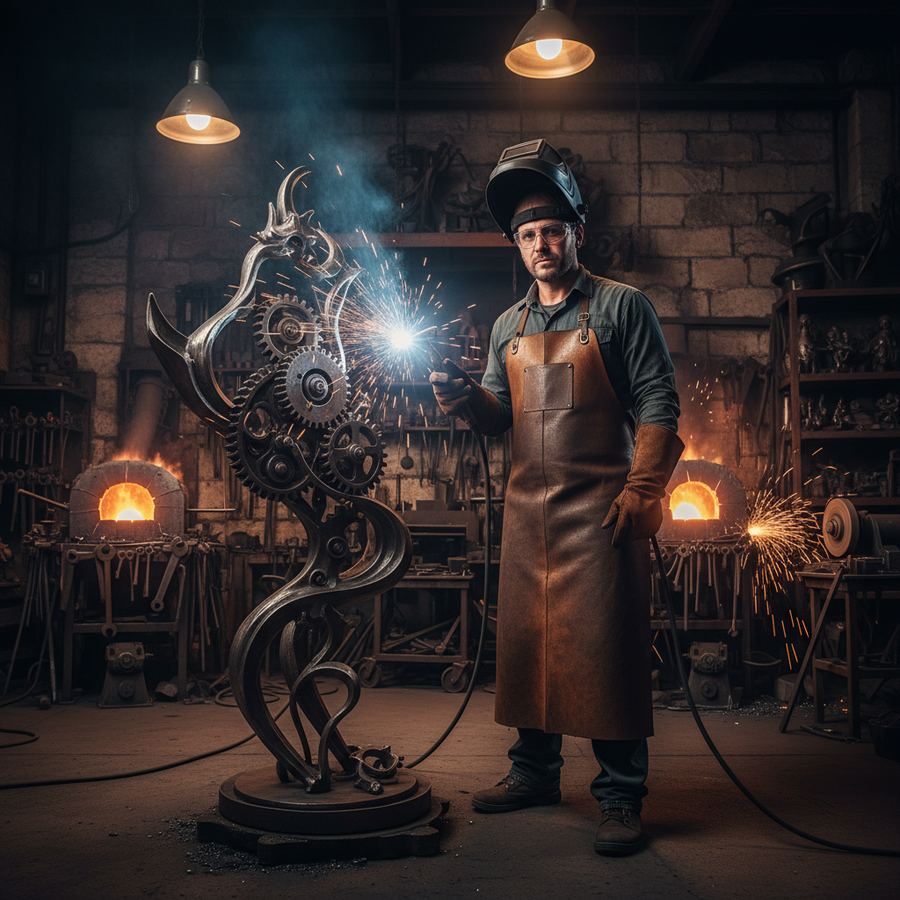
Creative welding techniques for sculpture, fabrication, and mixed-metal art
Welding as a Creative Language
Welding Art Fundamentals is a workshop designed for people who want to use welding as a creative tool rather than a purely industrial one. Offered through the Metal Arts Guild of Canada's network of teaching studios, this intensive introduces the three most common welding processes and applies them to sculptural and decorative projects from the very first day. Whether you have never touched a welding torch or have basic fabrication experience and want to redirect those skills toward art making, this workshop gives you the technical grounding and creative framework to begin building original work in metal.
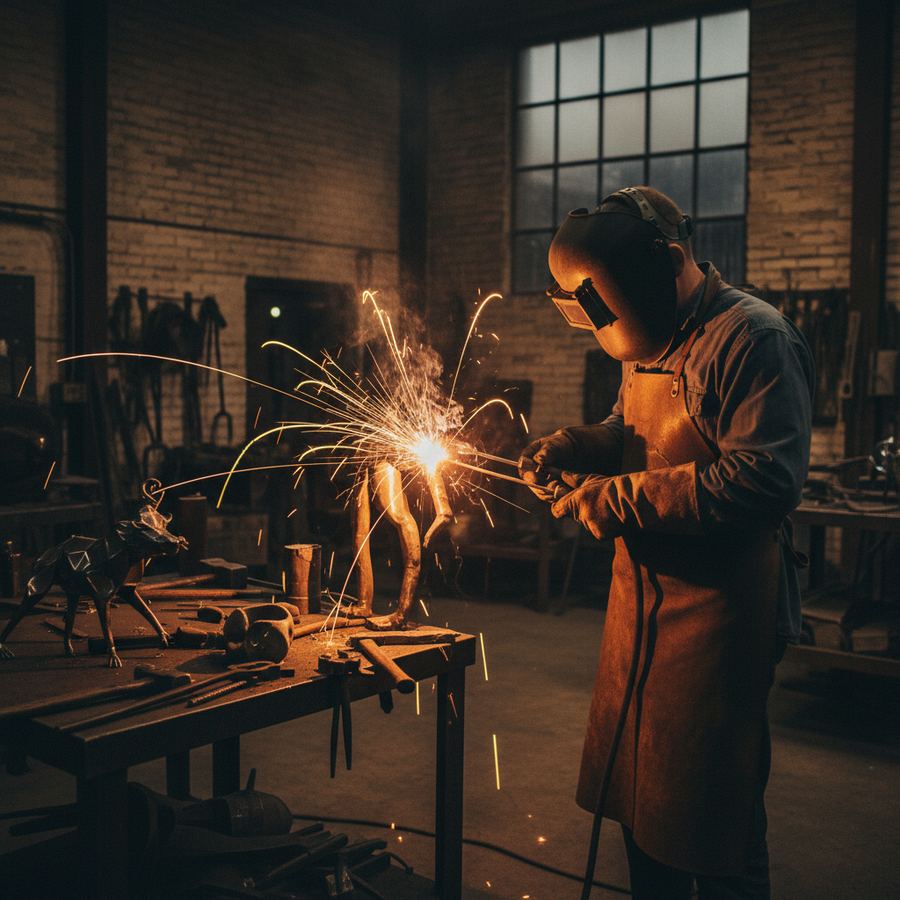
The course typically runs over three days or two extended weekends, depending on the host studio. Class sizes are limited to six participants to ensure safe supervision and meaningful individual instruction. All equipment, consumables, and base materials are provided. You leave with several completed projects, a working knowledge of three welding processes, and a clear sense of which process best suits the kind of work you want to make.
Process One: MIG Welding
The workshop opens with MIG (Metal Inert Gas) welding, also known as GMAW. MIG is the most accessible welding process for beginners because the wire feed is continuous and the shielding gas is supplied automatically through the torch. Your instructor demonstrates machine setup, including wire speed, voltage adjustment, and gas flow rate, then guides you through your first beads on flat plate. You practise flat, horizontal, and vertical runs, learning to read the arc and listen for the steady crackle that indicates correct settings. Within a few hours, most participants are laying clean, consistent beads and beginning to feel the relationship between travel speed, gun angle, and penetration.
Once the basics are established, you apply MIG welding to a small sculptural project. Common options include a wall-mounted candle sconce built from flat bar and sheet, or a freestanding abstract form assembled from cut tube and plate. The emphasis is on fit-up, joint preparation, and controlling distortion. These are the practical skills that separate a tidy weld from a functional joint in a finished piece. Your instructor discusses when to tack and when to run a full bead, how to sequence welds to minimize warping, and when grinding is appropriate versus leaving the weld bead visible as a design element.
Process Two: Oxy-Acetylene
The second process introduced is oxy-acetylene welding and cutting. This older technology remains indispensable for art metalwork because it offers unmatched versatility. With a simple change of tip, the same torch that welds steel can cut it, braze it, heat it for bending, or apply a decorative surface treatment. You learn to set up a torch rig safely, adjust flame types from carburizing to oxidizing, and run fusion welds on thin steel sheet without filler rod. You also practise oxy-acetylene cutting, guiding the torch along a marked line to produce clean, curved cuts that would be difficult or impossible with a mechanical saw.
The oxy-acetylene project often involves building a small found-object sculpture. Instructors bring a selection of salvaged steel parts, including gears, springs, bolts, brackets, and offcuts, and participants choose components that suggest a form. You cut, fit, and braze or weld the pieces together, making compositional decisions in real time. Found-object sculpture is a natural application for oxy-acetylene because the process lets you work gently with thin and delicate parts that would burn through under a MIG arc. It also connects to a deep tradition of welding art in Canada, where artists have been building from industrial salvage for decades.
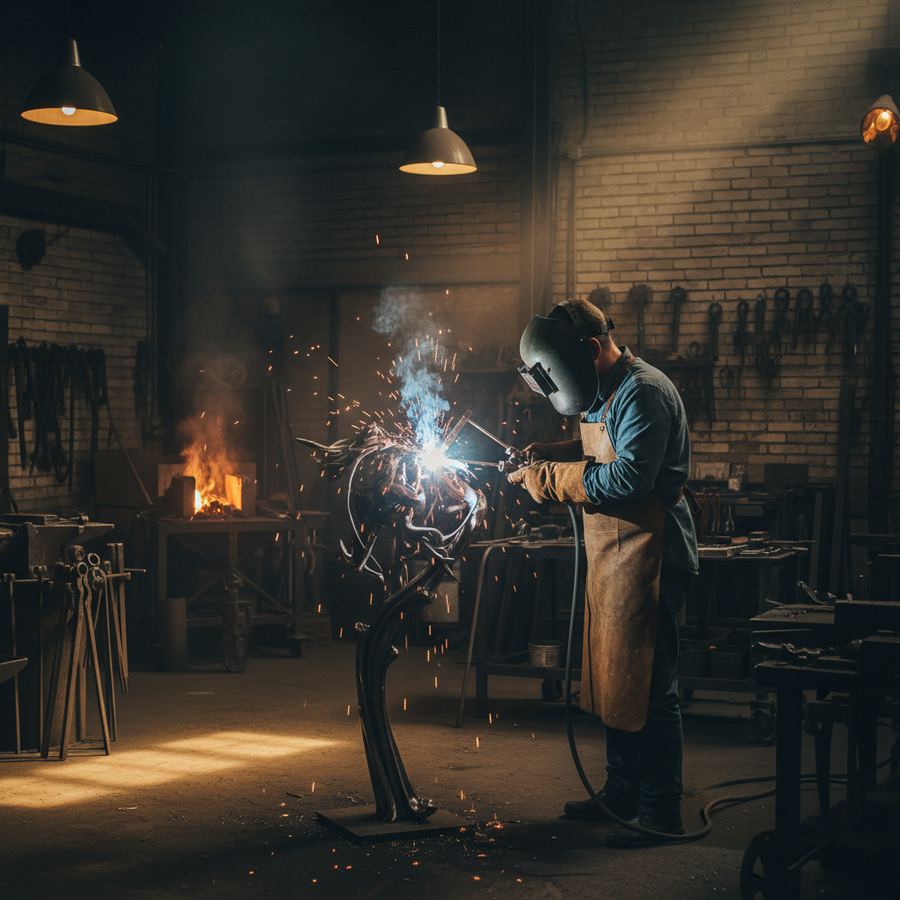
Process Three: TIG Welding
The final process is TIG (Tungsten Inert Gas) welding, also known as GTAW. TIG is widely regarded as the most precise and aesthetically refined welding process, but it demands the most coordination from the operator. You hold the torch in one hand and feed filler rod with the other while controlling amperage with a foot pedal. The learning curve is steeper, and the workshop treats TIG as an introduction rather than a mastery course. You practise on stainless steel and aluminum coupons, learning to establish a puddle, add filler in a consistent rhythm, and maintain a tight arc length. Even in a short session, the difference in weld appearance is striking. TIG beads are narrow, uniform, and often beautiful enough to leave exposed on finished work.
The TIG project is typically a small decorative object in stainless steel or copper: a napkin ring, a bud vase, or a simple picture frame. The scale is deliberately small because TIG rewards patience and fine motor control. For many participants, this session reveals TIG as the process they most want to develop further, particularly those with an interest in jewellery and fine metalwork where precision and surface quality are paramount.
Design and Composition
Throughout the workshop, instruction goes beyond pure technique to address design and composition. Your instructor discusses proportion, balance, negative space, and surface treatment as they relate to metal sculpture. You look at examples of professional welding art, analyse how the artists made structural and aesthetic decisions, and apply those principles to your own projects. The goal is not to produce imitative work but to develop a visual vocabulary that helps you think critically about form as you build it. Several past participants have described this as the most valuable aspect of the workshop, noting that technical skills alone do not produce compelling art without a framework for making design choices.
Finding a Session
Welding Art Fundamentals workshops are offered at studios in Ontario, British Columbia, Alberta, and Quebec. Scheduling varies by location, with most sessions running between April and November. Pricing ranges from three hundred to five hundred dollars depending on duration and materials included. Some studios offer the course as a three-day block, while others split it across two weekends to allow practice time between sessions. Check our workshops directory for current listings and registration details.
If you are interested in the broader landscape of forge-based craft, explore our introductory blacksmithing weekend for a complementary experience at the anvil. Ontario-based options are detailed on our Ontario regional page. For international welding art resources and events, the American Welding Society maintains a comprehensive directory. Whatever your starting point, the fundamental insight of this workshop is that welding is not just a means of joining metal. It is a creative act with its own aesthetic possibilities, and those possibilities are available to anyone willing to strike an arc.