Neil Fetterman | Saskatchewan | Blacksmithing
About the Practice
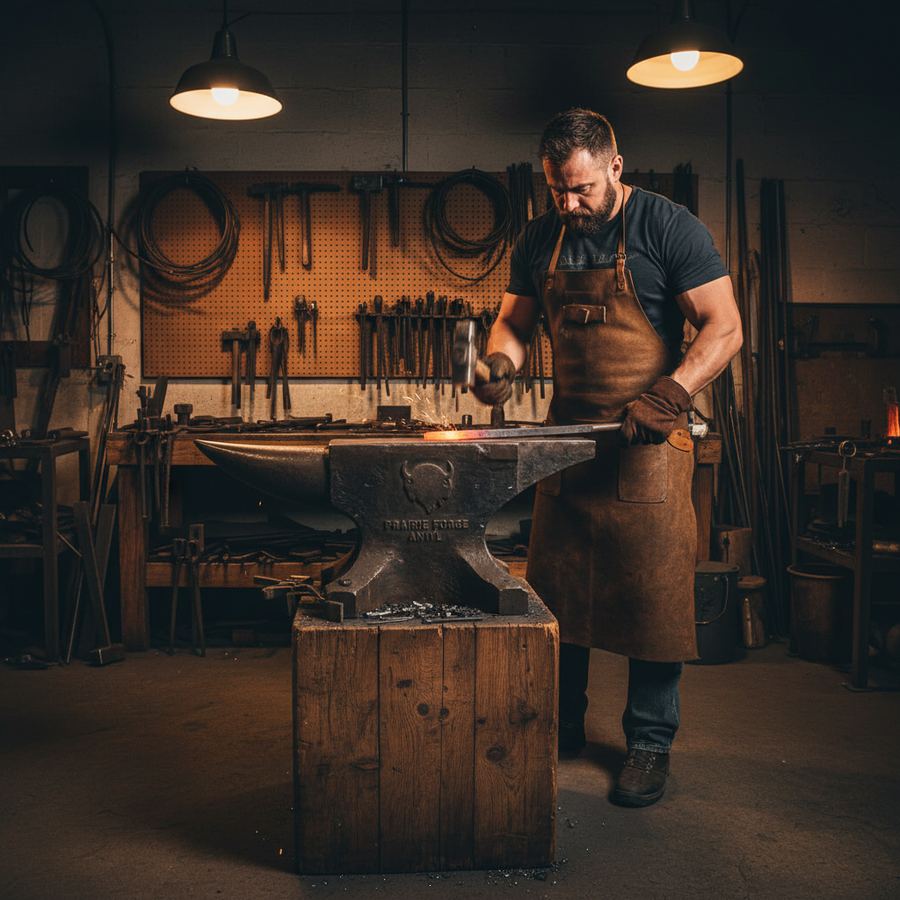
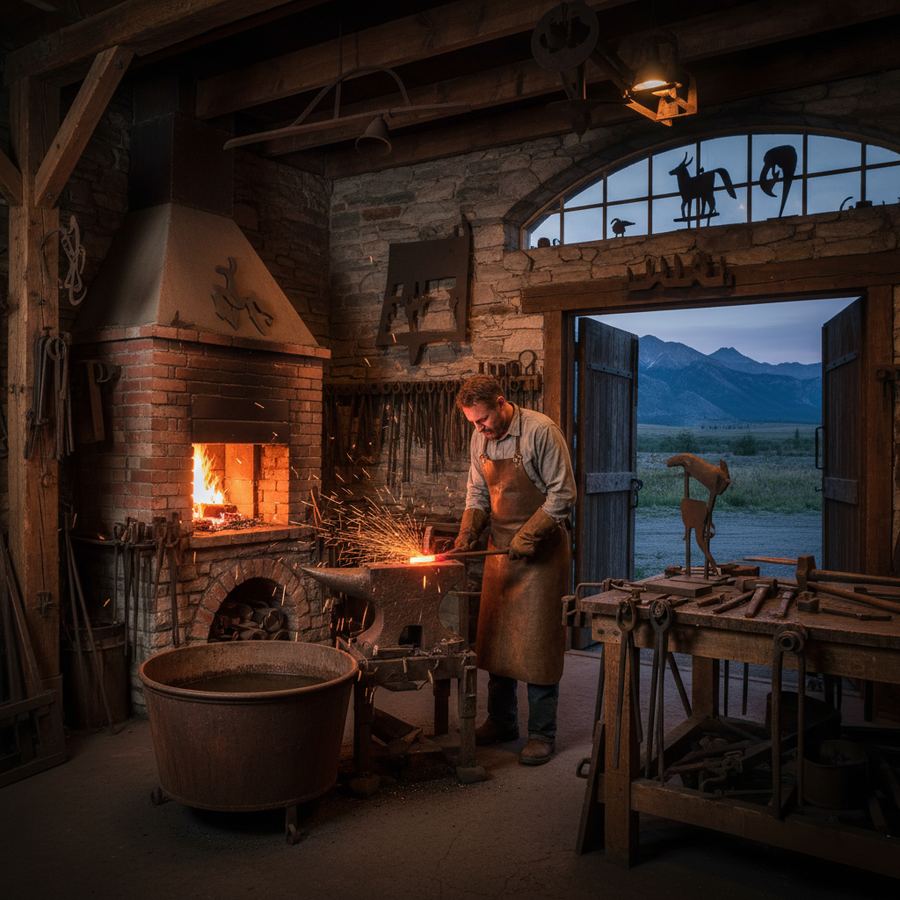
Prairie Forge stands at the end of a gravel section road eight kilometres south of Rosthern, Saskatchewan, surrounded by canola fields and open sky. The shop is a steel-clad Quonset with a concrete floor, insulated to survive the province's brutal winters. Blacksmith Neil Fetterman has worked from this location since 2010, having bought the property and its existing outbuildings from a retiring grain farmer. The Quonset, which previously housed a combine and a grain truck, was converted into a forge over two summers of weekends and evenings. Neil installed a chimney, poured a proper hearth pad, wired in three-phase power, and framed out a tool wall along the north side. The south wall holds a pair of overhead doors that open onto the yard, letting light and air flood the shop during the warm months and framing a view of flat agricultural land that extends to the horizon in every direction.
Neil grew up on a mixed farm near Hague, Saskatchewan, where practical metalworking was part of daily life. His father maintained a small shop for repairing equipment, and Neil learned to arc weld and cut with an oxy-acetylene torch before he finished high school. But blacksmithing, in the sense of forging hot steel on an anvil, was not part of his upbringing. He discovered it in his late twenties through a weekend workshop at the Saskatchewan Craft Council and was immediately captivated. Within months he had acquired a used anvil, a hand-cranked blower, and a coal forge made from a brake drum, and he was forging hooks and tongs in his father's shop after the day's farm work was done.
Agricultural Roots
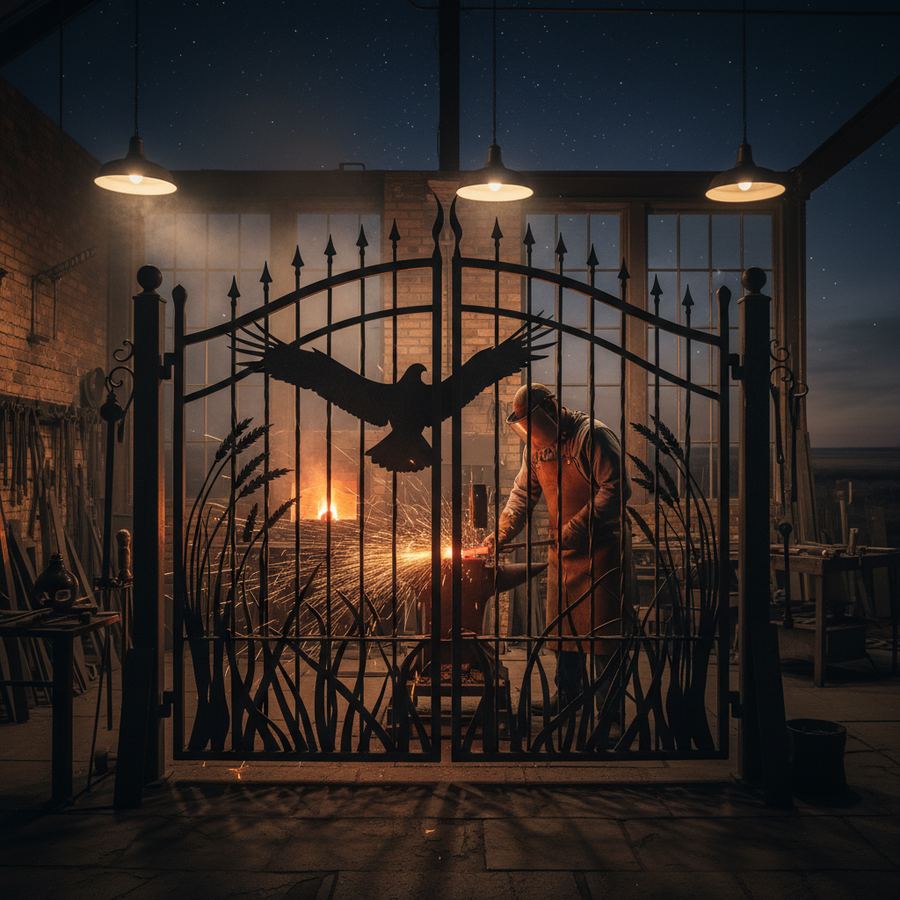
The agricultural context of Prairie Forge is not merely backdrop. It shapes the work itself. Neil's visual vocabulary draws heavily on the forms and implements of prairie farming: grain heads, fence wire, plow blades, harrow teeth, and the silhouettes of grain elevators against wide skies. His gates and railings frequently incorporate wheat and barley motifs forged from round and square bar stock, and he has developed a technique for creating convincing grain heads by upsetting the end of a bar and then splitting and shaping the individual kernels with a chisel. These botanical elements appear in much of his residential work and have become a recognizable signature of the studio.
He also produces functional objects rooted in farm life. Branding irons for ranchers in the parkland belt north of Saskatoon represent a steady source of work. Each brand must be forged to precise specifications registered with the provincial livestock authority, and the quality of the forging determines how cleanly the brand reads on the animal's hide. Neil takes this work seriously, forging each character and symbol from individual bars of mild steel that are then welded to a common backing plate and fitted with a handle. He has forged brands for ranches across Saskatchewan and into western Manitoba, and repeat customers are common.
Gates, Railings, and Architectural Work
Custom gates and railings form the core of Prairie Forge's commissioned work. Neil has designed and fabricated entry gates for farms, acreages, and rural estates throughout central Saskatchewan, ranging from simple functional designs to elaborate compositions featuring scrollwork, forged animal silhouettes, and family name plates. The scale of these projects varies widely. A basic ranch gate might be completed in a few days, while a complex estate entrance with stone pillars and matching pedestrian gates can occupy several weeks of forge time.
His approach to gate design is collaborative. Neil typically visits the site before beginning any design work, observing the landscape, the architecture of the home and outbuildings, and the character of the road or lane that the gate will frame. He photographs the setting, takes measurements, and talks with the client about their property's history and their vision for the entrance. From these conversations and observations, he develops pencil sketches that gradually refine into a final design. He does not use computer-aided design software, preferring the directness and flexibility of hand drawing. A full-scale layout drawn in chalk on the shop floor follows the approved sketch, and fabrication begins from there.
Interior work is less common but not absent from the portfolio. Neil has forged stair railings, fireplace tool sets, pot racks, and curtain rods for homes in Saskatoon, Prince Albert, and several smaller communities. These commissions tend to come through word of mouth, often from clients who encountered his work at a gate or saw one of his pieces at the Saskatoon Farmers' Market, where he maintains a periodic presence selling hooks, trivets, and small forged items.
Tool Making
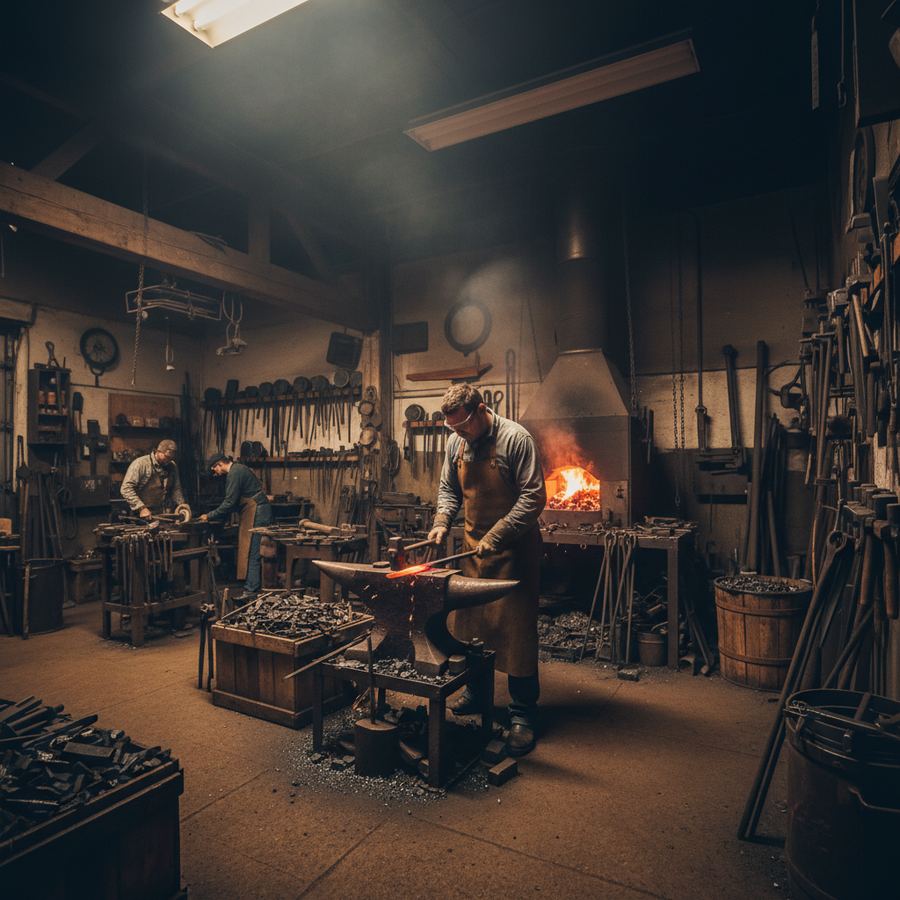
Like many blacksmiths who work in relative isolation, Neil has developed a deep practice of tool making. The nearest blacksmith supply dealer is hundreds of kilometres away, and waiting for shipped tools to arrive in rural Saskatchewan can mean days lost at the anvil. Out of necessity and then out of genuine interest, Neil began forging his own tongs, punches, chisels, fullers, swages, and other specialized tools. Over the years, this collection has grown to fill an entire wall of the shop, with each tool hung on a peg and labelled with a tag indicating its purpose and the date it was made. The tool wall is both a working resource and a record of Neil's development as a smith. Early tools show the marks of a learner still developing hammer control. Recent additions are crisp and confident, the work of a craftsman who has internalized the relationship between heat, force, and form.
Neil has also become skilled at forging hammers, a discipline that demands precise control of heat treatment. His cross-peen and rounding hammers are sought after by other smiths in the region, and he occasionally offers them for sale through blacksmithing networks and at the annual hammer-in hosted by the Saskatchewan Blacksmiths Guild. Forging a hammer from a block of medium-carbon steel, hardening and tempering the faces, and fitting a properly shaped handle is, Neil says, one of the most satisfying exercises in the craft. It is also one of the most demanding, requiring the smith to manage metallurgy, geometry, and ergonomics simultaneously.
Prairie Community
Prairie Forge serves a community where handmade things still carry weight. Saskatchewan's rural culture values self-reliance and practical skill, and a well-made gate or a properly forged branding iron earns respect. Neil's neighbours regard his work with the same appreciation they extend to a good welder, a skilled carpenter, or a farmer who keeps clean fences and straight furrows. This grounding in a community that understands physical labour and material craft is, for Neil, one of the great advantages of working where he does. He is not producing luxury goods for an urban market but useful objects for people who will test them daily against weather, livestock, and the hard use of working land.
He participates in the broader Canadian metal arts community through guild memberships and occasional travel to conferences and hammer-ins, but the core of his professional life is local. He is a regular exhibitor at the Rosthern craft fair and the Saskatchewan Handcraft Festival, and he opens his shop to visitors during Western Canada open studio weekends. These events bring curious members of the public into the shop, where Neil demonstrates forging and explains the process in plain, unpretentious language that reflects both his personality and his prairie upbringing.
Prairie Forge remains a small operation by intent. Neil works alone, with occasional help from his teenage son, who is showing early interest in the craft. The shop produces enough work to sustain a modest living, supplemented by occasional welding repairs for neighbours and seasonal farm work during harvest. It is not a glamorous existence, but it is an honest one, built on skill, persistence, and a genuine connection to the land and community that surround it. The hammer rings out across the canola fields, and the work goes on.