Jean-Philippe Morin | Quebec | Blacksmithing
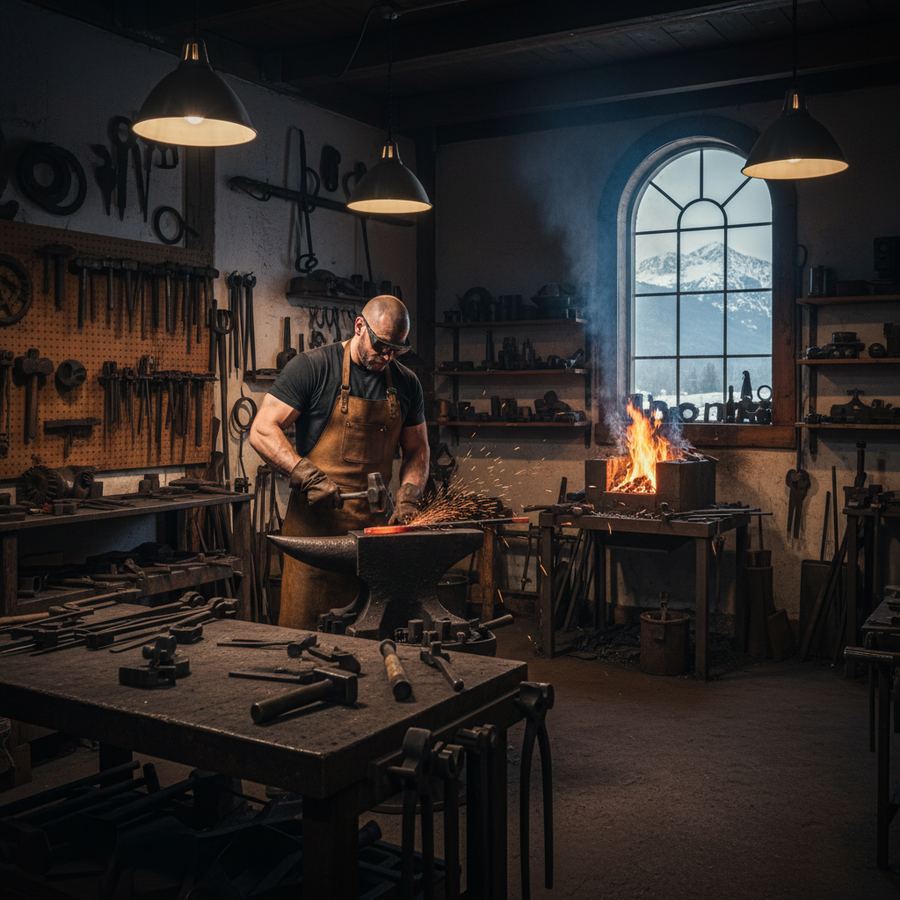
About the Practice
Northern Anvil Forge operates from a stone building in the village of Deschambault-Grondines, on the north shore of the St. Lawrence River between Quebec City and Trois-Rivieres. The building, originally a carriage house dating to the 1840s, was adapted for use as a blacksmith shop by Jean-Philippe Morin in 2008 after years of patient renovation. The thick stone walls keep the shop cool in summer and hold heat well in winter when the coal forge is running. The location places Jean-Philippe within one of the richest concentrations of heritage architecture in the province, and the proximity to old churches, manors, and institutional buildings has shaped the direction of his work in ways he did not fully anticipate when he first opened the doors.
Jean-Philippe came to blacksmithing through an unusual path. He studied art history at Universite Laval, with a focus on material culture and decorative arts in New France. His thesis examined surviving examples of seventeenth- and eighteenth-century ironwork in the Quebec City region, including hinges, latches, grilles, and liturgical objects preserved in churches and museums. The research required him to understand not just the visual characteristics of these objects but the techniques used to produce them. He began visiting working blacksmiths to learn the basics of forging, and what started as academic inquiry became a vocation. By 2005 he had committed to full-time smithing, training under several established Quebec blacksmiths and attending workshops in France to deepen his understanding of European traditions.
Liturgical and Ecclesiastical Work
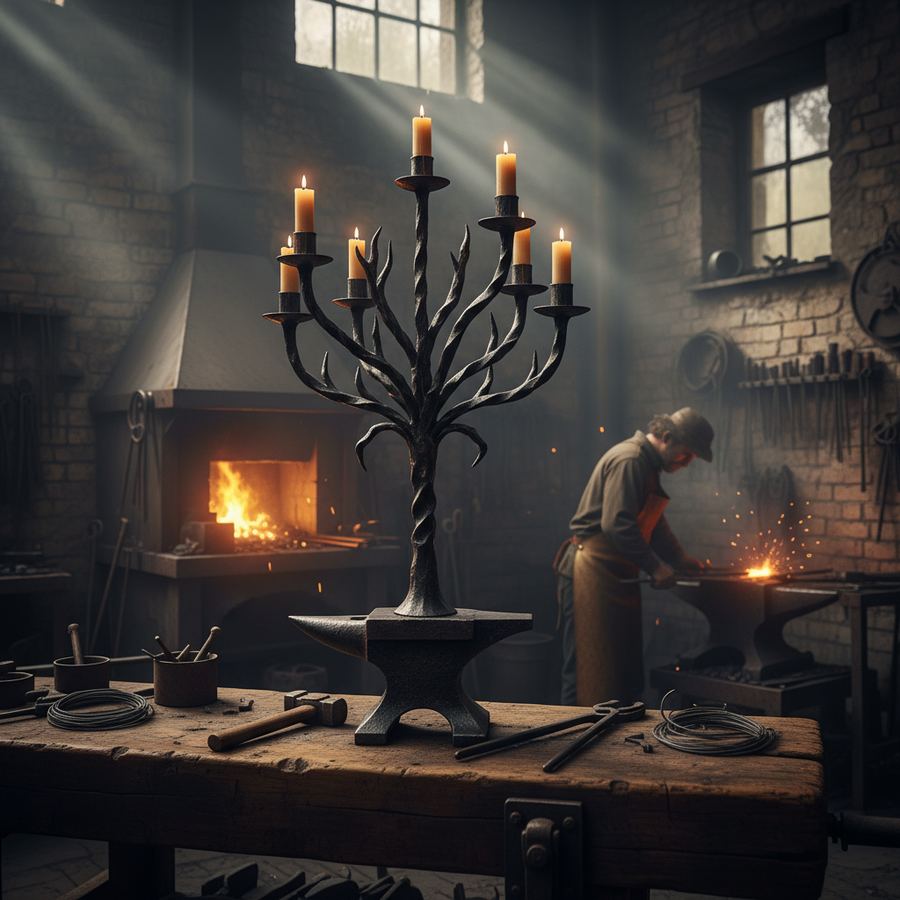
Northern Anvil Forge has developed a reputation for liturgical metalwork that is rare among contemporary Canadian blacksmiths. Jean-Philippe has forged candelabras, processional crosses, tabernacle doors, sanctuary lamps, and altar rails for churches across Quebec, including several designated as heritage sites by the provincial government. This work demands a particular sensitivity to historical style and symbolic meaning. A processional cross, for instance, must be beautiful as an object, functional as a liturgical instrument, and resonant with centuries of iconographic tradition. Jean-Philippe brings his art-historical training to bear on these commissions, researching precedents and consulting with clergy and heritage architects before beginning to forge.
His candelabras are perhaps the most admired products of this specialization. Standing between four and six feet tall, they feature twisted central columns, scrolled arms, and hand-forged drip pans, all assembled using traditional forge-welded and riveted joinery. The surfaces are left with a light forge scale and finished with paste wax, producing a dark, matte appearance that harmonizes with the aged wood and stone interiors of Quebec's historic churches. Jean-Philippe has completed candelabra commissions for parishes in Quebec City, Baie-Saint-Paul, and the Charlevoix region, and his work has been recognized by the Conseil du patrimoine religieux du Quebec for its contribution to the preservation of sacred material culture.
Heritage Restoration
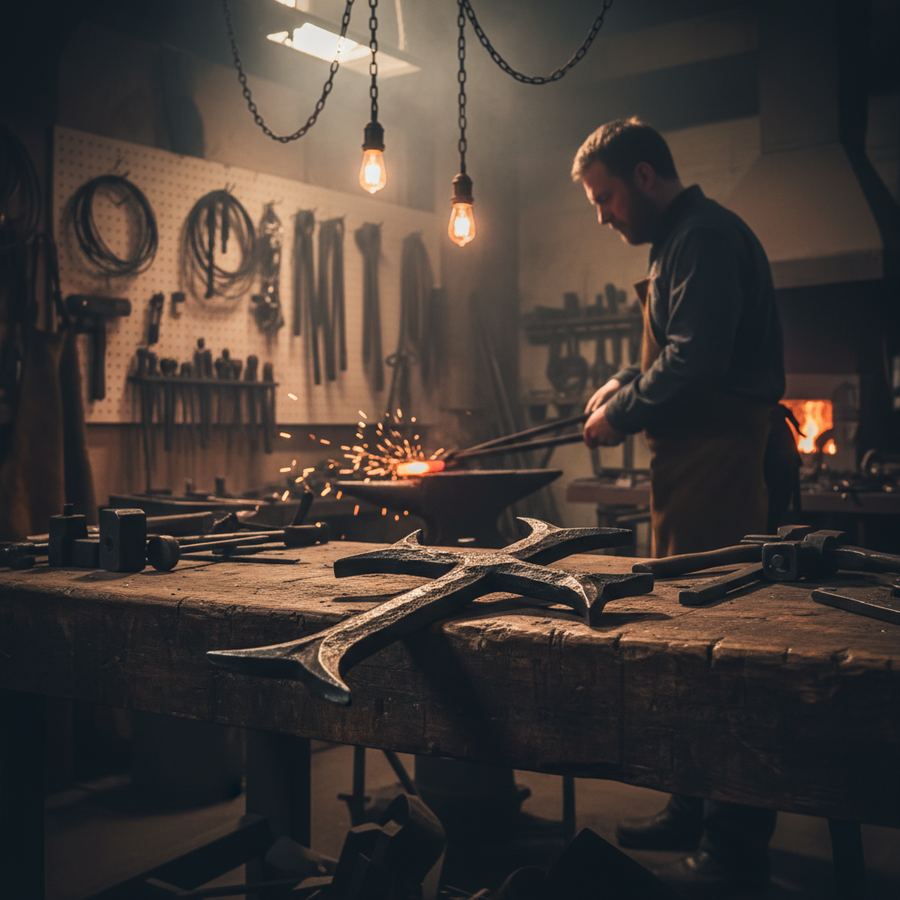
The restoration of historic ironwork constitutes a second major pillar of the practice. Jean-Philippe has worked on projects ranging from the repair of a single hinge on a chapel door to the comprehensive restoration of the wrought iron balcony railings on a nineteenth-century manor house. Each project begins with thorough documentation, including photographs, measurements, and, when possible, archival research into the original fabrication. He takes samples of original material for metallurgical testing, distinguishing between wrought iron, early mild steel, and cast iron, materials that require different repair strategies and cannot simply be interchanged.
His approach to restoration is guided by conservation ethics learned during his academic training. He favours minimal intervention, repairing rather than replacing wherever possible, and he insists that new material be subtly distinguishable from original work upon close inspection. This might mean leaving a slightly different hammer texture on a replacement element or using a different style of rivet head. The goal is honest repair that preserves the historical record embedded in the object while returning it to structural soundness and visual coherence. This philosophy sometimes puts him at odds with property owners who want their ironwork to look uniformly new, but Jean-Philippe has learned to explain his reasoning persuasively, and most clients come to appreciate the approach once they understand the cultural significance of the material they are custodians of.
Traditional Techniques
Northern Anvil Forge is distinguished by its commitment to traditional forging methods. Jean-Philippe uses a coal forge exclusively, favouring bituminous smithing coal from Nova Scotia for its consistent heat and low clinker production. His primary anvil is a 300-pound Peddinghaus, a German-made tool widely regarded as one of the finest production anvils available. He works with hand tools almost exclusively, reserving power tools for rough cutting and heavy grinding. Forge welding, the oldest method of joining iron, is central to his practice. He uses it not only for structural connections but as a decorative technique, layering different grades of steel to create pattern-welded surfaces that recall the laminated blades of historical edged weapons.
His interest in pattern welding has led to a sideline in hand-forged knives. While not a knifemaker by primary trade, Jean-Philippe produces a small number of pattern-welded kitchen knives and utility blades each year, sold through his studio and at the Salon des metiers d'art in Montreal. These knives feature blades forged from alternating layers of high-carbon and nickel-bearing steels, etched in acid to reveal the layered pattern, and fitted with handles of local hardwoods or birch bark. They are prized by collectors and culinary professionals alike, and the waiting list for new pieces extends several months.
The Quebec Blacksmithing Tradition
Jean-Philippe sees his work as part of a continuous tradition of blacksmithing in Quebec that stretches back to the earliest days of French settlement. The forges of New France produced everything from nails and tools to elaborate church hardware, and the skills were passed from master to apprentice across generations. The industrial revolution disrupted this continuity, as factory production replaced hand forging for most utilitarian objects, but a thread of traditional practice survived through the twentieth century in rural shops and heritage restoration workshops. Jean-Philippe's practice weaves together the historical knowledge of his academic training and the physical skills of his forge work, creating objects that honour the past while serving the present.
He is an active contributor to the Canadian metal arts community, participating in conferences, contributing articles to craft publications, and hosting visiting smiths at his Deschambault shop. He has also been involved in efforts to document surviving heritage ironwork in the St. Lawrence corridor, working with heritage organizations to photograph and catalogue objects that might otherwise be lost to neglect or uninformed renovation. This documentation work, unglamorous but essential, reflects the same impulse that drives his creative practice: a belief that hand-forged metalwork carries cultural meaning that transcends its material function, and that this meaning is worth preserving.
Studio Life
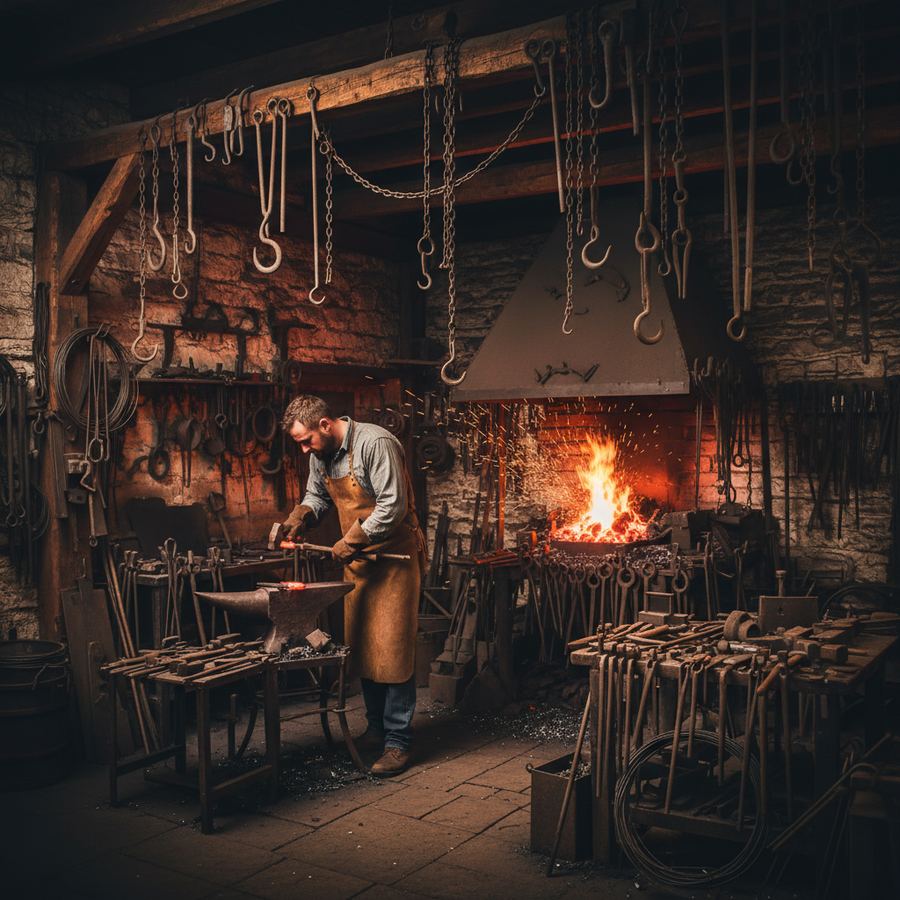
Northern Anvil Forge operates on the rhythms of the forge fire and the Quebec seasons. Spring and summer bring the busiest period for restoration work, when scaffolding can go up and exterior ironwork can be removed, repaired, and reinstalled. Autumn is devoted to liturgical commissions and studio projects. Winter, when the shop is at its most atmospheric, with firelight reflecting off stone walls and the forge casting long shadows, is reserved for knife forging, tool making, and the kind of experimental work that sustains Jean-Philippe's creative energy through the darker months.
Visitors to the shop often comment on the quietness of the work. Contrary to the popular image of blacksmithing as relentless noise and sparks, much of Jean-Philippe's day is spent in contemplation: examining a piece of historical hardware under a magnifying lamp, sketching designs at the drafting table, or simply watching the fire and waiting for steel to reach the right colour before bringing it to the anvil. It is this combination of physical skill and intellectual engagement that first drew him to the craft and continues to hold him. The forge at Deschambault is both a workshop and a library, a place where the traditions of the past are not merely studied but practised, day after day, at the anvil.