Fiona MacLeod | Nova Scotia | Metal Art
About the Practice
Harbour Metals operates from a converted fish shed on the waterfront in Lunenburg, Nova Scotia, one of the most photographed towns in Atlantic Canada and a UNESCO World Heritage Site. Metal artist Fiona MacLeod has worked from this small but well-equipped studio since 2014, producing sculptures, weathervanes, architectural metalwork, and functional objects that draw their imagery and spirit from the maritime culture of the South Shore. The studio overlooks the harbour where wooden schooners and fishing boats still tie up at the wharf, and this daily proximity to working waterfront life feeds directly into the work.
Fiona grew up in Pictou, Nova Scotia, in a family with deep roots in the province's industrial history. Her grandfather worked at the Trenton steelworks, and her father was a millwright at a pulp mill in Abercrombie. She absorbed an understanding of metal and mechanical things early, but her path to art was not direct. She studied fine art at NSCAD University in Halifax, graduating in 2004 with a concentration in sculpture. Her early work used found objects and mixed media, but she gravitated increasingly toward metal as her primary material. A summer job in a Halifax fabrication shop gave her welding skills, and a year-long residency at a community forge in Cape Breton introduced her to hot forging. By 2010 she was working primarily in steel, copper, and bronze, combining welding, forging, and cold metalworking techniques in a hybrid practice that resists easy categorization.
Maritime Imagery
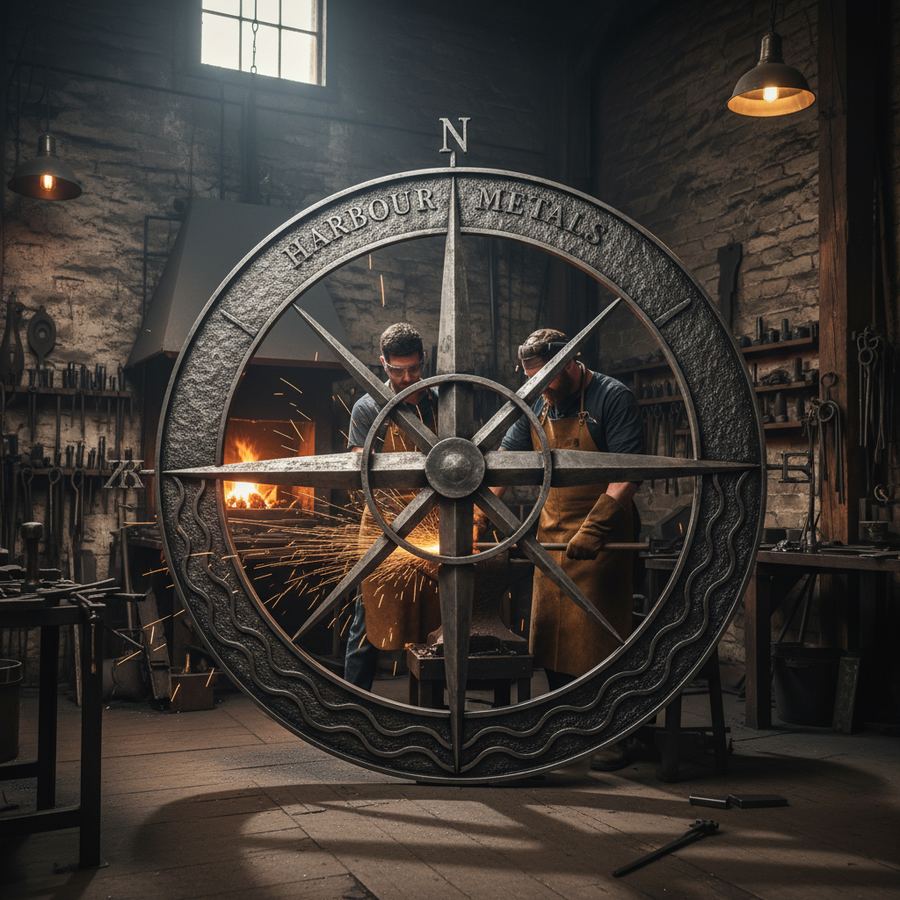
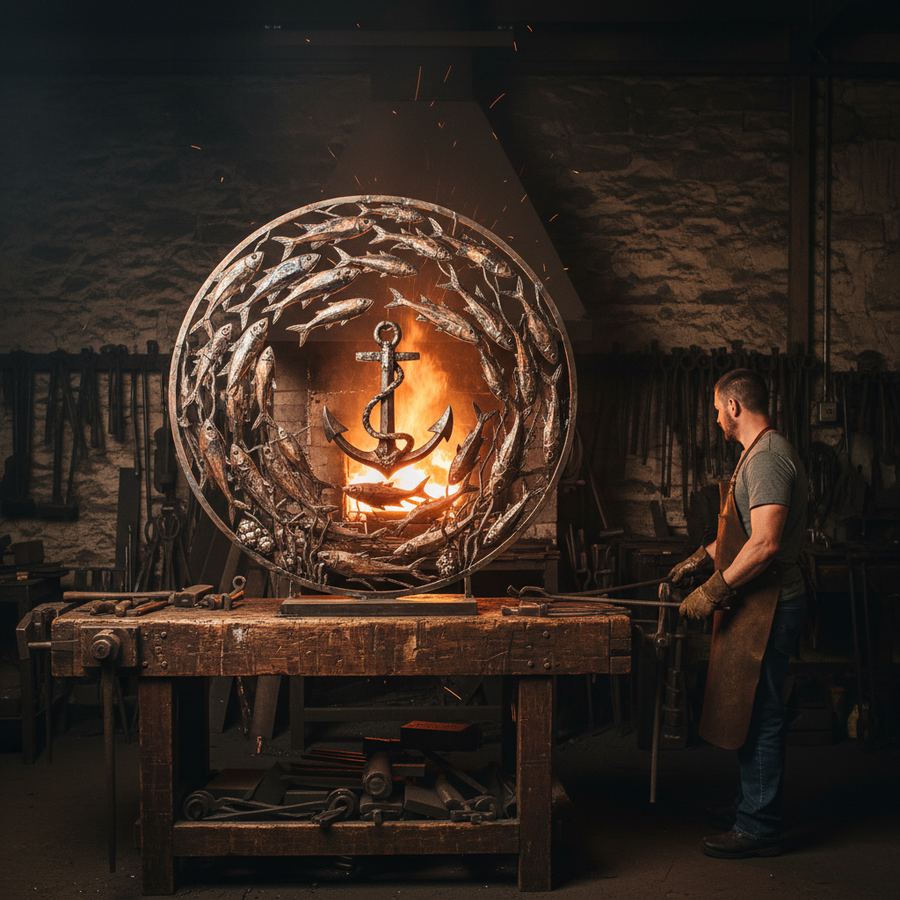
The imagery of Harbour Metals is rooted in the Atlantic coast. Fish, anchors, compass roses, waves, lighthouses, boats, rope, and nautical hardware appear throughout the body of work, treated with varying degrees of abstraction. A compass rose wall piece might be rendered with geometric precision, its points and cardinal markings cut from sheet steel with a plasma torch and welded to a circular backing plate. A school of fish, by contrast, might be a loose, gestural arrangement of forged steel forms, each fish a few hammer blows away from the bar stock it started as, the whole group mounted on a driftwood plank or a section of salvaged ship timber.
Fiona is careful to distinguish her work from the decorative nautical kitsch that proliferates in tourist shops along the Nova Scotia coast. Her pieces engage with maritime culture seriously, drawing on the visual richness of the working waterfront without sentimentalizing it. A sculpture of a cod, for instance, references not only the beauty of the fish but the collapse of the Atlantic cod fishery and its devastating impact on coastal communities. A weathervane in the shape of a schooner honours the shipbuilding tradition of Lunenburg while acknowledging that the era of commercial sail is past. This layer of cultural awareness elevates the work beyond mere decoration and gives it substance that rewards sustained attention.
Weathervanes and Architectural Pieces
Weathervanes have become a signature product of Harbour Metals. Fiona fabricates them from sheet copper and brass, cutting profiles with aviation snips and a jeweller's saw, then raising three-dimensional forms using hammers, stakes, and sandbags. The technique is closely related to traditional coppersmithing, and Fiona has studied historical weathervane construction through museum collections and conservation literature. Her vanes feature schooners, whales, codfish, lobsters, herons, and compass arrow designs, all mounted on custom-forged steel spindles with brass directional letters. Over time, the copper develops a green patina that complements the painted clapboard and weathered shingle of Maritime architecture. Several of Fiona's weathervanes are installed on heritage buildings in the Lunenburg area, where they serve as functional wind indicators and as public art visible from the harbour and the surrounding streets.
Architectural commissions extend beyond weathervanes. Fiona has produced gate panels, sign brackets, interior railings, fireplace screens, and decorative wall mounts for residential and commercial clients across Nova Scotia. A notable project was a set of copper-clad exterior light fixtures for a boutique hotel in Mahone Bay, designed to complement the building's Victorian architecture while introducing a contemporary sensibility. The fixtures feature cut and pierced copper shades that cast patterned light on the facade at night, creating a subtle interplay between metalwork and illumination. Projects like this demonstrate the range of Harbour Metals and Fiona's ability to move between the sculptural and the functional with equal confidence.
Materials and Process
Fiona works across a broader range of metals than many artists in her field. Mild steel forms the backbone of her structural and sculptural work. Copper and brass are reserved for weathervanes, smaller sculptures, and accent elements where warmth and patina are desired. She also works with bronze, primarily for cast elements that she farms out to a small foundry in the Annapolis Valley and then chases and finishes in her own studio. Stainless steel sees occasional use in coastal installations where salt exposure demands superior corrosion resistance.
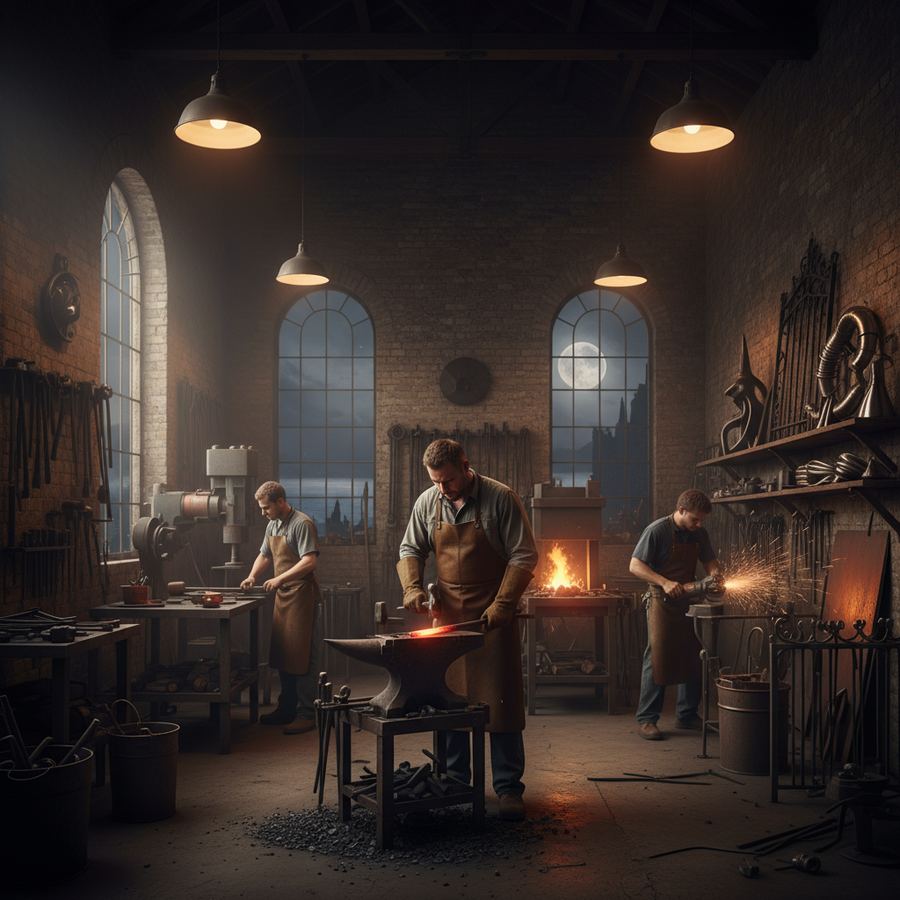
The studio is compact but thoughtfully organized. A welding station, a small coal forge, a workbench with a machinist's vise, and a jeweller's bench with a GRS engraving system occupy the main room. Sheet metal tools, including shears, stakes, a planishing hammer, and a small English wheel, are arranged along one wall. The plasma cutter lives in a curtained alcove near the back door, where sparks and fumes can vent directly outside. Fiona has adapted her workflow to the constraints of the space, and the intimacy of the studio suits the scale of much of her work. Larger pieces are assembled outdoors on the wharf when weather permits, taking advantage of the harbour light and the open air.
Community and the South Shore
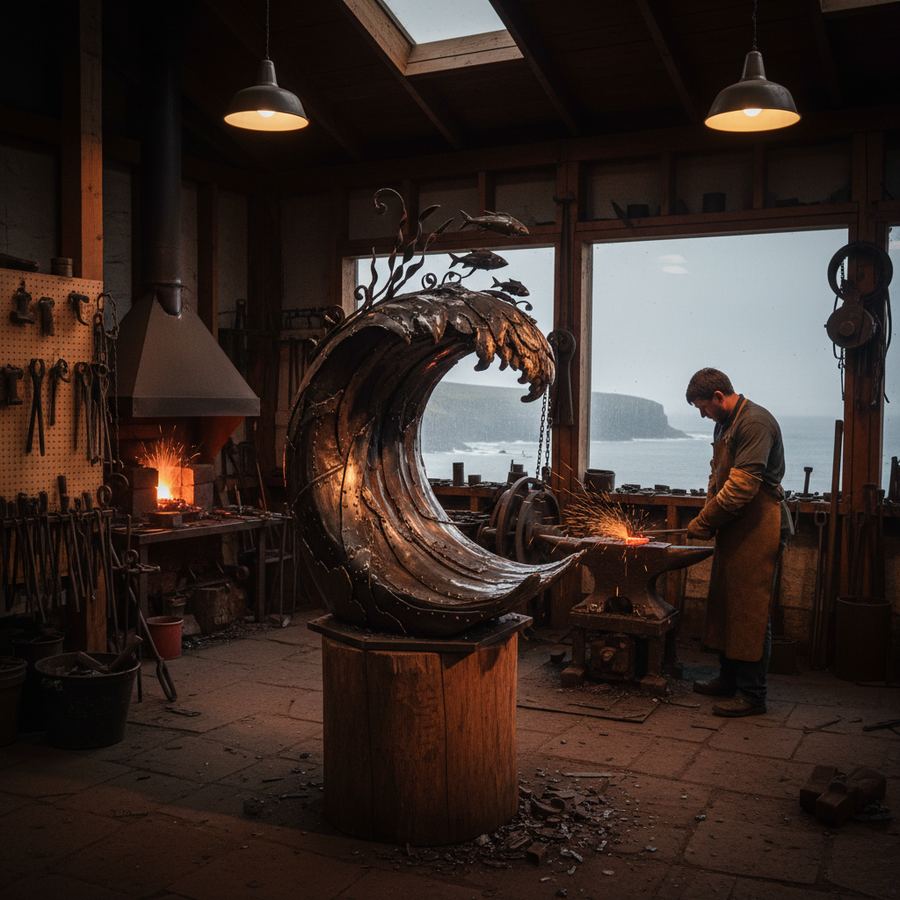
Harbour Metals is embedded in the arts community of Lunenburg and the broader South Shore. Fiona participates in open studio events, group exhibitions, and the annual Lunenburg Doc Fest, where she has created sculptural installations for the festival's waterfront venues. She maintains relationships with other craftspeople in the area, including woodworkers, potters, and textile artists, and she has collaborated on several projects that combine metal with other materials. A recent collaboration with a local boatbuilder produced a series of wall-mounted sculptures combining forged steel with steam-bent oak ribs salvaged from a decommissioned fishing vessel. The pieces sold out at their first exhibition and prompted a second series.
Fiona is also engaged with the broader conversation about metal art in Canada and the role of craft in Atlantic Canadian culture. She has written about the challenges of sustaining a studio practice in a region with a small population and limited institutional support for the arts. These challenges are real, but she argues that the compensations are equally real: a strong sense of community, affordable studio space, proximity to the landscapes and cultures that inspire the work, and an audience that values handmade objects because it comes from a tradition of making and mending things by hand. The Atlantic Canada metal arts community is small but deeply committed, and Fiona's practice is a vital part of it.
Looking forward, Fiona plans to expand her weathervane production and to develop a line of smaller copper and bronze objects, including ornaments, desk accessories, and small sculptural editions, that can reach a national audience through online sales and select gallery representation. She is also pursuing a public art commission for the Halifax waterfront, a large-scale compass rose that would be her most ambitious project to date. Whatever direction the work takes, it will remain anchored in the harbours and headlands of the Nova Scotia coast, where the salt air, the working boats, and the long tradition of Maritime craft continue to provide both inspiration and purpose.